Choosing the right network cabling is very important for any commercial building. Offices, hospitals, schools, warehouses, and retail stores all depend on strong and stable internet connections. If the cabling system is not properly planned, businesses may face slow speeds, poor connectivity, and future upgrade issues.
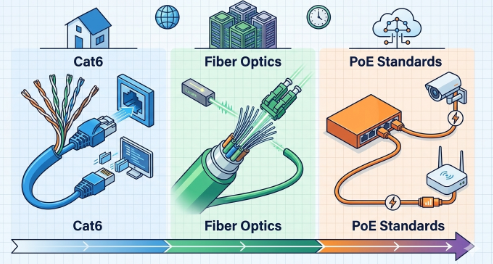
Today, the most common options in commercial networking are Cat6 copper cables, fiber optic cables, and PoE (Power over Ethernet) standards. Each option has its own strengths and is designed for different needs. Some are better for short distances, while others are ideal for high-speed data over long ranges.
Understanding the differences among Cat6, fiber, and PoE will help business owners make a smart, cost-effective decision for both current use and future growth.
Let’s explore more about them.
What Is Cat6 Cabling?
Cat6 (Category 6) is a type of copper Ethernet cable widely used in commercial buildings. It is designed to handle high-speed data transmission.
Key features of Cat6:
- Supports speeds up to 1 Gbps for 100 meters
- Can support up to 10 Gbps for shorter distances
- Affordable and easy to install
- Commonly used in offices and small businesses
Cat6 is a good choice for most indoor networking needs, such as computers, printers, VoIP phones, and security cameras. It is cost-effective and works well for standard business operations.
However, Cat6 has distance limits. If the cable run exceeds 100 meters, signal quality drops. It is also more sensitive to electrical interference compared to fiber.
What Is Fiber Optic Cabling?
Fiber-optic cables use light signals rather than electrical signals to transmit data. This makes them extremely fast and reliable.
Key features of Fiber:
- Very high speed (10 Gbps and beyond)
- Can run over long distances (hundreds or thousands of meters)
- No electrical interference
- Very secure data transmission
Fiber is ideal for large commercial buildings, data centers, campuses, and industrial facilities. It supports heavy data usage and future expansion.
The main drawback is cost. Fiber cables and installation are more expensive than copper cables. Specialized tools and trained technicians are also required.
What Is PoE (Power over Ethernet)?
PoE is not a cable type. It is a technology standard that allows electrical power and data to travel through the same Ethernet cable. Cat6 cables commonly support PoE.
PoE is useful for:
- IP security cameras
- Wireless access points
- VoIP phones
- Smart building devices
With PoE, there is no need for separate power wiring for each device. This reduces installation cost and makes setup simpler.
There are different PoE standards, like:
- PoE (802.3af)
- PoE+ (802.3at)
- PoE++ (802.3bt)
Each standard provides different power levels depending on device requirements.
Cat6 vs Fiber vs PoE Standards: Comparison Table
| Feature | Cat6 | Fiber Optic | PoE Standard |
| Speed | Up to 10 Gbps (short range) | Extremely high | Depends on the cable used |
| Distance | Up to 100 meters | Very long distance | Same as an Ethernet cable |
| Cost | Affordable | Expensive | Cost-effective |
| Power Supply | No | No | Yes (via Ethernet cable) |
| Best For | Offices | Data centers | Cameras & IoT devices |
Which Option Is Best for Your Business?
The best choice depends on your building size, budget, and plans.
- Small to medium offices: Cat6 with PoE support works well.
- Large commercial buildings: Fiber backbone with Cat6 distribution is common.
- Smart buildings and security systems: PoE-enabled Cat6 is ideal.
Many modern commercial setups use a combination of fiber and Cat6 to balance performance and cost.
Key Takeaway
There is no single “best” cabling option for every commercial building. Cat6 is affordable and practical. Fiber offers high speed and long-distance reliability. PoE adds flexibility by powering devices through the network cable.
A well-planned network infrastructure often combines these technologies to create a fast, scalable, and future-ready system. Choosing wisely today can save businesses from expensive upgrades tomorrow.