In today’s commercial buildings, reliable network connectivity is extremely important. From offices to hospitals, malls, factories and data centres, every commercial building relies heavily on stable network signals. However, many businesses face dropped connections or poor call quality. One key reason behind these problems is signal interference. Commercial networks must be designed carefully to maintain consistent performance and avoid these disruptions.
Understanding why signal interference happens and how proper cabling helps prevent it can improve network performance and reduce daily disruptions.
What is Signal Interference?
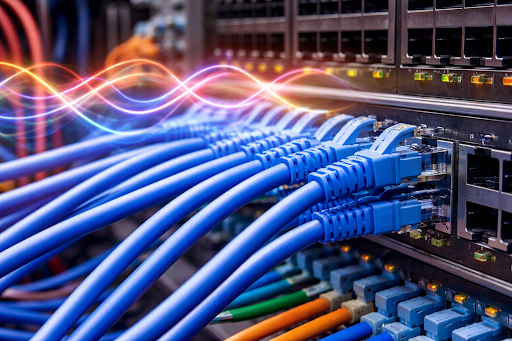
Signal interference occurs when unwanted signals disturb or weaken the original network signal. Instead of travelling smoothly from one point to another, the signal gets mixed with noise, causing delays, data loss or poor connection quality.
In commercial environments, where multiple devices operate simultaneously, interference is common. Computers, servers, wireless access points and communication systems all share the same space, increasing the chance of signal disruption.
Common Causes of Signal Interference in Commercial Networks
Highlighting some of the most common causes of signal interference in commercial networks.
Electromagnetic Interference (EMI)
Many electric devices produce electromagnetic waves. Equipment, including generators, elevators, fluorescent lights, power cables and heavy machinery, may cause EMI. These waves disturb nearby network signals, especially when network cables run close to power lines.
Radio Frequency Interference (RFI)
Wireless devices such as WI-FI routers, mobile phones, security systems and Bluetooth devices use radio frequency. Operating multiple devices on similar frequencies may cause signals to overlap and interfere with one another. This leads to slower data speeds and weak connections.
Poor Cable Quality
Low-quality or damaged cables are more likely to pick up external noise. Thin insulation or weak shielding allows outside signals to enter the cable, which affects data transmission. Over time, wear and tear can escalate the problem.
Improper Cable Installation
Incorrect cable routing is another main cause of interference. When data cables are placed too close to electrical wiring or heavy equipment, interference becomes more likely. Besides, poor installation increases the risk of physical damage.
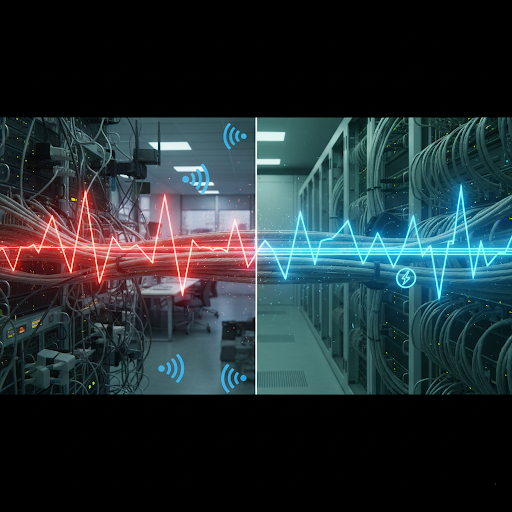
How Proper Cabling Helps Prevent Signal Interference
Here’s how proper cabling helps prevent signal interference.
Shielded Cabling Reduces Noise
High-quality network cables mostly include shielding that blocks external signals. Shielded twisted pair (STP) cables, for example, protect data signals from electromagnetic and radio interference. This helps keep the signals clean and stable.
Twisted Pair Design Improves Signal Strength
Many network cables use twisted pairs of wires. Twisting helps cancel out interference by balancing electrical noise. This design allows data to travel more efficiently, even in busy commercial environments.
Fibre Optic Cables Eliminate Interference
Instead of electrical signals, fibre optic cables use light. Because of this, they are not affected by electromagnetic or radio interference at all. This makes fibre optics ideal for high-speed and high-security commercial networks.
Proper Cable Routing and Separation
Professional cabling ensures that network cables are installed at a safe distance from power lines and heavy equipment. Organized cable management reduces exposure to interference and improves long-term reliability.
Reliable Performance and Fewer Network Issues
When proper cabling is used, businesses experience fewer dropped connections, faster data transfer, and more stable communication systems. This leads to improved productivity and reduced maintenance costs.
Bottom Line
Signal interference is a common problem in commercial networks, but it is not unavoidable. Electrical devices, wireless signals, and poor-quality cables all contribute to interference.
However, using high-quality cabling, proper shielding, and professional installation can greatly reduce these issues. Investing in the right cabling solution ensures a stronger, more reliable network that supports daily business operations without interruptions.